Room Tone: The Sound That Makes Silence Feel Occupied
Room tone gives film scenes a lived-in acoustic space. Learn how to choose, place and check its texture so quiet moments feel present rather than empty.
Room tone keeps a film’s quiet moments attached to a place. In a kitchen, that might be a soft ventilation wash; in a room above a road, it could include distant traffic. This low background layer helps dialogue edits feel continuous and gives silence an acoustic character without turning the sound itself into the subject.
For viewers, room tone is a way to hear how a scene holds together. For editors and sound teams, it is also a practical tool: the room does not become acoustically blank when its occupants stop speaking. The useful question is which sounds support the scene’s point of view, and where they should sit.
Room tone gives silence a location
Film silence is often relative. Dialogue, music and prominent action may fall away while a faint bed of environmental sound remains. A close, soft hush can make a room feel enclosed; a broader wash with distant traffic can connect it to the street outside.
The bed need not reproduce every object visible in the frame. A steady electrical hum may create a more coherent impression than a collection of individually recognisable appliance noises. If viewers begin identifying a machine, the sound may draw attention away from the faces and gestures the scene asks them to watch.
Room tone can also keep a quiet interior from feeling like an abstract void. Pipes settling or a distant door closing may suggest that the building continues around a solitary character. Such details work best when they are felt as part of the space, not announced as separate effects.
Build the sound in a clear sequence
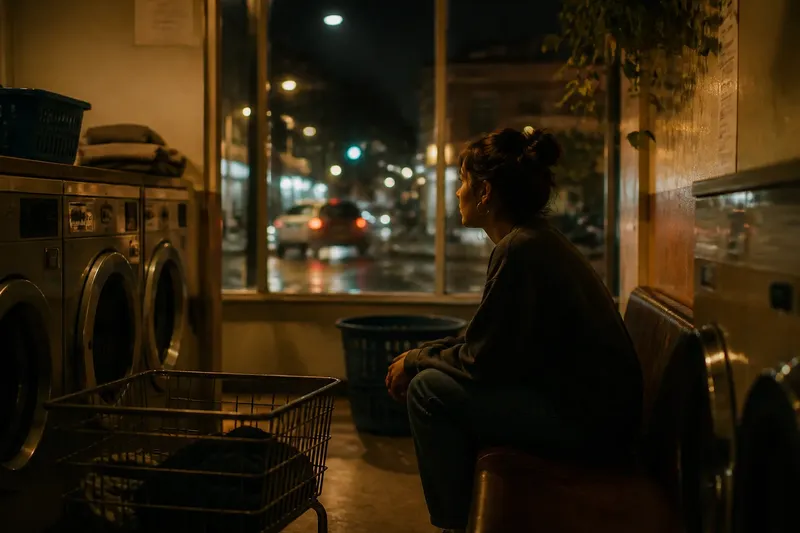
Imagine an editor working on a late-night laundrette scene whose dialogue pauses feel oddly vacant. The starting inputs are a dialogue edit, the picture, and candidate recordings of a low interior wash, distant traffic and a washer cycle. The aim is to make the pauses feel continuous while keeping the machines from competing with the characters. Each pass below makes a specific decision before the next layer is added.
First, decide what the room should feel like
Watch the scene and note its intended acoustic point of view: cosy, exposed, institutional or tense. Then listen to the dialogue and effects for clues. A dry, close voice may suggest a compact space; a lingering reflection may suggest more volume around the speaker.
Write down one base sound that supports the intended feeling and one sound to avoid. For the laundrette, the team might choose a low interior wash as the base and reject a prominent light buzz because it would pull focus. The result is a simple brief for choosing layers, rather than a list of every sound that could belong in the room.
Next, choose only layers with distinct jobs
Audition the candidate sounds beneath the dialogue. The interior wash establishes the room; distant traffic connects it to the neighbourhood; the washer cycle can suggest activity when the scene needs it. These layers do different work, so they should not all be equally prominent.
Check each candidate against the scene’s focus. If a sound is noticeable but does not clarify place, distance or action, leave it out. A faint clock tick, buzzing light, rattling vent and distant voices can compete even when each sounds plausible alone; adding all of them may turn a quiet scene into a sound-effects demonstration.
Then, carry the bed across edits
Place the steady room tone under dialogue and carry it through the pauses. Listen at each cut, especially when the camera changes angle or moves to another part of the room. If the background jumps, adjust the edit or layer so the space sounds continuous, unless the cut is meant to create a deliberate rupture.
Continuity does not mean every moment must be identical. A door opening can admit a brighter corridor sound, while a character moving towards a window can make traffic more apparent. Let the change follow the action rather than the arrival of a new shot.
Finally, check what the audience notices
Listen once with the picture and once without it. With the image, ask whether the bed supports a pause or distracts from it. Without the image, ask whether the scene still feels like one place and whether any layer becomes conspicuous without a reason.
Make a final pass at a modest listening level. The question is not whether every layer can be heard on its own; it is whether the combined scene feels stable and purposeful. If the background masks dialogue or calls attention to itself, lower or remove the responsible layer.
Use each sound check to make a decision
A short review list can keep a room-tone pass focused. For every item, check the stated observation and make the corresponding choice; if the first option does not fit, use the alternative.
- Check whether dialogue pauses suddenly lose their background; if they do, carry a steady room-tone bed through them, but if the scene is meant to feel abruptly empty, leave the drop in place.
- Check whether the base layer suggests the room’s intended size and mood; if it does, keep it, but if it feels too close or too open, choose a more suitable recording or adjust the blend.
- Check whether an intermittent sound clarifies distance or action; if it does, place it where that information matters, but if it only attracts attention, remove it.
- Check whether the background changes at a camera cut without an on-screen cause; if it does, smooth the transition, but if the cut is meant to unsettle the audience, preserve the change.
- Check whether a doorway or window changes the scene’s acoustic perspective; if it does, let the relevant corridor or exterior layer rise naturally, but if the sound contradicts the picture, keep the original bed steady.
- Check whether the room tone competes with a line of dialogue; if it does, reduce or clear the masking layer, but if speech remains clear and the space feels present, keep the balance.
- Check whether a sound becomes conspicuous when listening without the picture; if it does and the image gives no reason for it, lower or remove it, but if it carries essential spatial information, retain it at a less prominent level.
Say the laundrette editor starts with a dialogue track whose pauses drop to near-silence, plus three candidate layers: an interior wash, distant traffic and a rattling vent. The editor first lays in the interior wash and carries it across the cuts; the pauses now share a stable background. Next, the editor adds traffic only near the window, where the picture supports an outside connection. The vent rattles over a quiet line, so the editor removes it. The resulting decision is to keep the steady wash, use traffic selectively and omit the vent: the room remains present without distracting from the dialogue.
Recording room tone is not recording silence
On set, a crew may record a stretch of a location’s background sound while people remain quiet and equipment stays still. That recording can help fill dialogue gaps and smooth edits. It may include air conditioning, distant street activity or the building’s resonance; it is a sample of the space at that moment, not a promise of acoustic purity.
In post-production, room tone can also be assembled from other suitable recordings or designed from layers. A real location may have inconsistent noise, or the scene may need a character the recording did not capture cleanly. The source and the function are different questions: a fabricated layer can still create a believable space if it fits the scene’s point of view.
Room tone answers practical listening questions?
How is room tone different from ambience?
The terms overlap in everyday use. Room tone often means a relatively steady background bed tied to a particular space, while ambience can include a wider field of activity, such as traffic, birds or distant voices.
In practice, a sound team may use both terms for layers that establish a location. The distinction matters less than the role each layer plays in the scene.
Why can silence sound awkward after an edit?
If dialogue is removed and nothing fills the gap, the background may drop abruptly between lines or shots. That change can make the edit feel exposed, as though the room itself vanished.
A consistent low-level bed can preserve the acoustic impression across the cut. If the sudden absence is deliberate, however, retaining it can create unease.
Does every scene need room tone?
No. A deliberately stark passage may benefit from near-silence, and a sudden reduction in background sound can unsettle the audience.
Choose based on the scene’s intended effect: continuity, isolation or rupture. A layer is useful when it serves that effect, not simply because a room is visible.
Can room tone be heard on headphones?
Headphones can make subtle layers easier to notice, especially in a scene with little dialogue. Listen for a steady floor beneath pauses, then compare it with moments when a door opens or the camera moves.
The point is not to identify a particular appliance, but to hear how the space persists and changes.
Choose layers for what the scene needs
A useful room-tone pass starts with a steady base where the location needs continuity, then adds occasional sounds only when they clarify distance, movement or mood. In the laundrette, the low interior wash can continue throughout, while a passing vehicle briefly rises outside and fades. The washer need not churn loudly in every shot simply to remind us it is there.
Chasing a perfectly isolated recording of a supposedly silent room is not worth the effort. Real places are rarely silent, and a film does not need a forensic catalogue of every noise. A clean, coherent impression often serves the scene better than a technically pristine layer that feels disconnected from the image.
Room tone is easy to miss until it changes. Listen for whether the background persists through a pause, shifts at a doorway or disappears without cause. That small check can tell you whether the quiet belongs to the room the film has shown.