When Audiences First Heard a Film: The Change to Synchronized Sound
Synchronized sound in film history reshaped cinema’s live performance, acting and audience attention—and explains why early talkies could feel thrilling yet constrained.
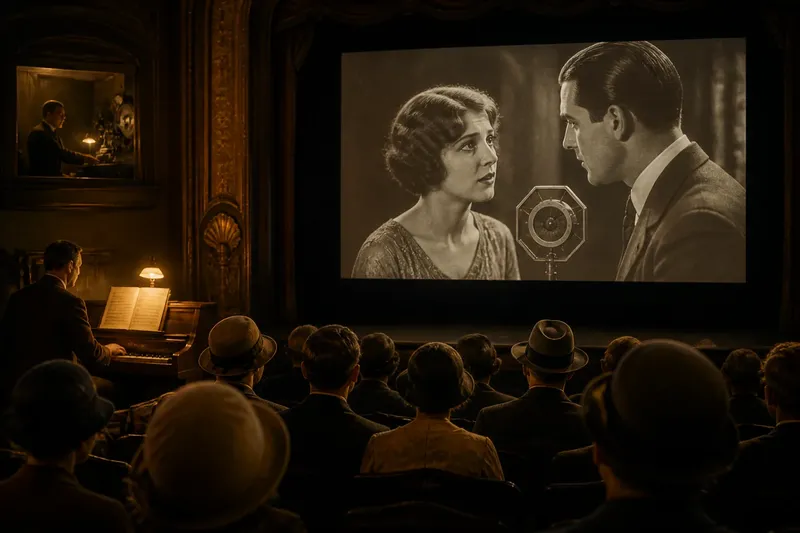
Synchronized sound in film history changed the cinema from a performance completed in the room to one increasingly fixed on the film itself. In the late 1920s, systems such as Vitaphone, which played a disc in step with the projector, and Movietone, which recorded sound optically on film, brought recorded voices and music to commercial screens. Their arrival was not a single overnight switch: theatres adopted equipment at different times, and silent films and live accompaniment continued alongside sound productions.
The change was vivid, but it was not simply a matter of adding dialogue. A pianist or lecturer could adjust to the mood of a particular audience; recorded sound carried the same timing and performance from one screening to the next. Early equipment and production methods also imposed limits, though the precise constraints varied by system, studio and theatre. Those details help explain why some early talkies feel startlingly intimate while others seem stiff or crowded.
Synchronized sound in film history moved performance from the room to the print
A silent film was not necessarily a quiet film. Musicians supplied mood and rhythm, while lecturers could introduce the story or explain unfamiliar details. Accompaniment varied among cinemas and performances. The screen supplied the images; the room helped complete the event.
Recorded sound altered that relationship. A voice could arrive with a moving mouth, while a door slam or footstep seemed to belong to the image. The soundtrack travelled with the film, so a cinema could reproduce a planned performance rather than rely on a local musician’s interpretation. That consistency was part of the appeal, but the screening became less responsive to the room.
With Vitaphone, sound was recorded on discs that had to remain synchronised with the film; with optical sound, the audio information appeared as a track on the film itself. These systems worked differently, and neither description means every screening ran flawlessly. A disc, projector or theatre set-up could cause trouble, while optical recording brought its own technical demands. The broad historical point is that synchronisation became a production and exhibition problem, not just an artistic choice.
Early sound equipment could make timing problems conspicuous
If image and sound fell out of step, a mouth might keep moving after a line seemed to finish, or a word could appear to arrive too early. Such a mismatch could turn tenderness into accidental comedy. It is safer to describe this as a possible presentation problem than as a universal feature of early sound: the risk depended on the system, the condition of the equipment and how the screening was managed.
Sound also affected production. Some early talkies used sound-conscious sets and microphone arrangements that could limit camera or actor movement. The details differed among films; there was no single microphone arrangement imposed on every production. For a viewer, however, the result can be visible in scenes that cluster around a speaking position or hold a shot longer than its visual action seems to require.
When a scene feels out of step, distinguish a persistent mismatch from an artistic choice. Repeatedly detached speech suggests a synchronisation or playback issue; an unusual effect confined to one moment may be deliberate. One odd beat alone cannot establish the cause.
Recorded voices changed acting and dialogue
Silent performers built meaning through gesture, expression and movement, with intertitles supplying words when needed. Synchronized dialogue added the demands of speech, microphone placement and recording. A broad gesture that read clearly across a theatre could seem excessive beside an audible voice, while a small pause or vocal inflection could carry meaning that titles once had to spell out.
The transition was not a simple division between actors who could and could not perform. A voice brought qualities such as accent, texture and rhythm into the audience’s attention, and filmmakers had to decide how speech should share space with images. The adjustment varied from film to film and from performer to performer.
Some early sound films use dialogue heavily, but that should not be treated as the whole period’s style. A production might foreground speech because recorded voices were a new attraction, or because its scenes retained habits associated with stage dialogue. When a line merely describes visible action, the soundtrack can feel like an addition rather than a new expressive layer.
Fixed soundtracks changed music and audience attention
Live accompaniment could respond to a comic reaction, follow the pace of a scene or colour a familiar image differently each evening. A recorded score offered consistency while removing that nightly exchange. It could also seem to dictate an emotion: music that swells before a character notices a threat pushes the audience towards suspense, even if the image remains ambiguous.
Imagine a small cinema showing a fictional suspense scene with a recorded cue that grows louder before the character turns towards a doorway. The starting point is an uncertain image and a fixed soundtrack; the screening keeps that cue in place rather than letting a local musician vary it. The expected result is that viewers hear a clear prompt to anticipate danger, though they may still interpret the image differently.
Sound redirected attention as well. A line could carry information once supplied by an intertitle, while a noise beyond the frame invited viewers to imagine an unseen space. Yet speech and music could compete with a face, gesture or glance. Effective sound did not need to fill every pause: silence could make a reply, a distant noise or a held expression more noticeable.
Why can an early sound film feel static?
Why do characters seem to speak from one spot?
Some early productions arranged scenes around microphones or sound-conscious sets, which could restrain movement. The extent varied by film and system; a fixed-looking scene is a clue to consider, not proof of one specific technical cause.
Why does dialogue sometimes explain the obvious?
Filmmakers were working out how recorded speech should complement images, and some scenes rely on dialogue to carry information the picture already supplies. In other cases, the talk may reflect a deliberate preference for verbal explanation rather than a technical limitation.
Why can sound seem detached from the room?
A recorded voice or musical cue repeats as part of the film, unlike a musician visibly performing in the cinema. That fixed presentation can make the fictional soundscape feel distinct from the audience’s actual surroundings.
Why do some scenes feel more convincing than others?
Sound feels integrated when it supports, complicates or extends the action on screen. When speech, music and movement all compete for attention without a clear relationship, the scene can feel awkward, whatever the equipment.
What is not worth the effort
It is not useful to judge every early talkie by whether it resembles a later film with more mobile sound recording. Nor should every stiff scene be celebrated as an ingenious response to technology: some are simply less effective. Listen for what sound changes—where it directs attention, what it makes newly present and what it leaves to the viewer.
The shift was from sound performed around the film to sound increasingly fixed as part of its recorded form. For anyone exploring synchronized sound in film history, the useful distinction is not “silent” versus “talking” alone. It is also the difference between a performance shaped afresh in a cinema and one whose voices, music and timing travelled with the film.